Participatory Governance
Users can help shape selected platform priorities, proposals, visibility, curation, and ecosystem decisions.
The Ozeaon DAO is the participatory governance layer where meaningful contributors can help shape platform priorities, knowledge curation, project visibility, and ecosystem development.
Instead of giving influence to whoever can buy the most tokens, Ozeaon's governance model is designed to reflect learning, publishing, collaboration, support, and contribution over time.
DAO and token infrastructure is being built on Celo, selected for its low-cost participation, ReFi alignment, and sustainability relevance.
The Ozeaon DAO is being built as a participatory governance and stewardship layer for the platform.
Its purpose is to allow contributors to help shape how knowledge, projects, opportunities, platform features, and ecosystem resources evolve over time.
The DAO is not designed as a speculative investment club or a simple token-voting mechanism. It is intended to become a contribution-informed governance system where influence is connected to meaningful participation and protected by ethical stewardship.
Users can help shape selected platform priorities, proposals, visibility, curation, and ecosystem decisions.
Governance participation is linked to Progress, a non-transferable contribution credential earned through meaningful activity.
Blockchain-enabled governance and participation flows run on Celo because of its low-cost, real-world, ReFi-aligned infrastructure.
The Foundation helps ensure governance remains aligned with ethics, mission integrity, safety, and long-term regenerative values.
Ozeaon is being built as an ecosystem, not a static platform. As users publish articles, build projects, create resources, list open calls, form organisations, and support regenerative work, the platform will need ways to decide what is elevated, improved, funded, integrated, or prioritised.
Governance matters because contribution should not disappear — when users help build knowledge, review content, or strengthen the ecosystem, their participation should create visible trust and future influence, turning participation into stewardship.
DAO participation helps make contribution visible and consequential.
Contributors can help shape selected topics, features, and ecosystem priorities.
Progress rewards participation, not purchased influence. Celo keeps governance low-cost and accessible.
Foundation stewardship supports ethical, legal, safety, rights, and mission-alignment review.
At the centre of Ozeaon's governance model is Progress, a non-transferable contribution token, designed to recognise meaningful participation across the platform — including learning, publishing, project support, collaboration, content contribution, review, funding activity, and ecosystem participation.
Progress is not intended to be bought, sold, or traded as a governance currency. Its role is to show that a user has contributed value over time, helping protect governance from pay-to-play capture.
Completing educational activities, future quizzes, tutorials, or knowledge pathways.
Submitting articles, resources, research-informed content, tutorials, or media.
Creating, supporting, joining, updating, or contributing to regenerative projects.
Funding projects, donating tips, or supporting ecosystem activity where eligible.
Participating in community review, feedback, content curation, or proposal assessment.
Contributing to organisations, Pods, bounties, partnerships, or cross-disciplinary initiatives.
The Ozeaon DAO is expected to support governance across selected areas of platform activity as the ecosystem matures.
Different proposal types require different discussion periods, thresholds, review pathways, or Foundation checks depending on risk and significance.
Governance Areas
Help prioritise emerging themes, regional needs, new knowledge categories, and underrepresented areas.
Help prioritise, review, elevate, or adapt high-value knowledge contributions into learning pathways.
Support recognition, curation, and visibility for high-value articles, tutorials, media, and ecosystem storytelling.
Help identify projects that should receive greater visibility, community support, review, or future funding pathway attention.
Support curation and prioritisation of relevant opportunities, grants, fellowships, and accelerators, improving discoverability for users and organisations.
Propose and vote on selected feature requests, design improvements, usability needs, and functionality changes.
Support trust, verification signals, ecosystem participation, and partnership visibility over time.
Support selected ecosystem activities, campaigns, and working groups. Pods specifically coordinate around topics, proposals, projects, or ecosystem needs.
Future task-based governance may support research, peer review, data collection, design, or development needs.
In later phases, participate in decisions around tokenised IP, digital assets, or strategic ecosystem assets — including IP-NFT acquisition, licensing, and other strategic resources.
Help refine participation rules, proposal categories, review processes, and DAO standards.
DAO participation should be designed to be clear, structured, and contribution-informed.
Users do not need to start as governance experts. They may begin by learning, publishing, supporting projects, contributing to discussions, or building useful work across the platform.
Engage with educational resources, future quizzes, tutorials, and knowledge pathways.
Publish articles, create projects, support open calls, review content, or participate in ecosystem activity.
Meaningful actions may generate Progress, the non-transferable contribution credential.
Eligible users may participate in proposal discussion and structured review.
Users may vote directly or delegate participation in future governance workflows where supported.
Governance helps shape platform priorities, content curation, project support, and future ecosystem resources.
The DAO supports structured proposal creation, discussion, review, and voting.
Not every proposal should be treated the same. A suggestion to add a new resource category does not carry the same risk as a treasury decision, rights-sensitive decision, or platform-wide governance change.
Ozeaon's DAO model allows different proposal types to have different thresholds, review periods, and safeguards.
A user or organisation submits a proposal with category, purpose, rationale, expected impact, and supporting information.
The proposal is categorised by type, risk, platform area, and required review pathway.
The proposal may undergo community, expert, technical, editorial, legal, or Foundation review depending on scope.
Eligible users can discuss, ask questions, suggest revisions, and raise concerns during a defined period.
Progress-eligible users vote directly or through delegated pathways where available.
Quorum, approval thresholds, and category-specific conditions are checked.
For higher-risk proposals, Foundation or advisory review may confirm ethics, safety, rights, and mission alignment.
Approved proposals are implemented where feasible, with progress updates, documentation, and accountability.
Ozeaon's DAO and token infrastructure is built with blockchain technology that supports practical usability, low-cost participation, real-world payments, regenerative finance, and sustainability-conscious digital coordination. Celo is the blockchain environment for Ozeaon's Phase 1.5 rollout because it offers a strong combination of technical accessibility and mission alignment.
As an Ethereum Layer 2, Celo supports fast, low-cost, real-world transactions — with one-block finality, sub-cent fees, and payment-focused design that keeps governance, rewards, tipping, funding, bounties, subscriptions, and participation mechanics affordable and inclusive.
Its relevance goes beyond technical: Celo's strong ties to regenerative finance, mobile-first access, financial inclusion, and climate-conscious infrastructure make it more coherent with Ozeaon's regenerative model than a blockchain chosen only for speculative liquidity or technical throughput.
Celo's low transaction costs are important for a platform where users may make frequent small contributions, tips, donations, votes, bounties, or funding actions.
Celo's mobile-first history and accessibility orientation support Ozeaon's long-term ambition to reach broad, geographically diverse users.
Celo's public materials describe an environmental fee-allocation mechanism connected to carbon offsetting and climate impact. According to current transaction documentation this allocation is up to 10% of their fees.
Celo's focus on payments, stablecoins, DeFi, and real-world financial access supports Ozeaon's future funding and participation flows.
Celo is strongly associated with regenerative finance and mission-aligned blockchain builders, making it a natural fit for Ozeaon's ReFi positioning.
As an Ethereum Layer 2, Celo gives Ozeaon compatibility with the broader Ethereum ecosystem while supporting lower-cost, real-world activity.
Governance rights are linked to Progress, a non-transferable contribution signal, rather than simple token purchasing power. This helps reduce pay-to-play governance and supports influence based on ecosystem value creation.
Governance influence is linked to Progress and contribution, not purchased token concentration.
Progress is designed as a contribution credential, not a speculative asset.
Token and DAO actions use infrastructure that supports low-cost, frequent, real-world participation.
Different proposal types can require different eligibility, quorum, review, and approval thresholds.
Proposal deposits, reputation requirements, or submission limits may help prevent low-quality governance activity.
Higher-risk proposals may require ethical, legal, rights, safety, or mission-alignment review.
Governance processes, smart contract logic, proposal status, and voting outcomes are auditable and visible where appropriate.
Blockchain infrastructure should be evaluated not only for speed or cost, but for its relationship to ecological impact, accessibility, and regenerative value.
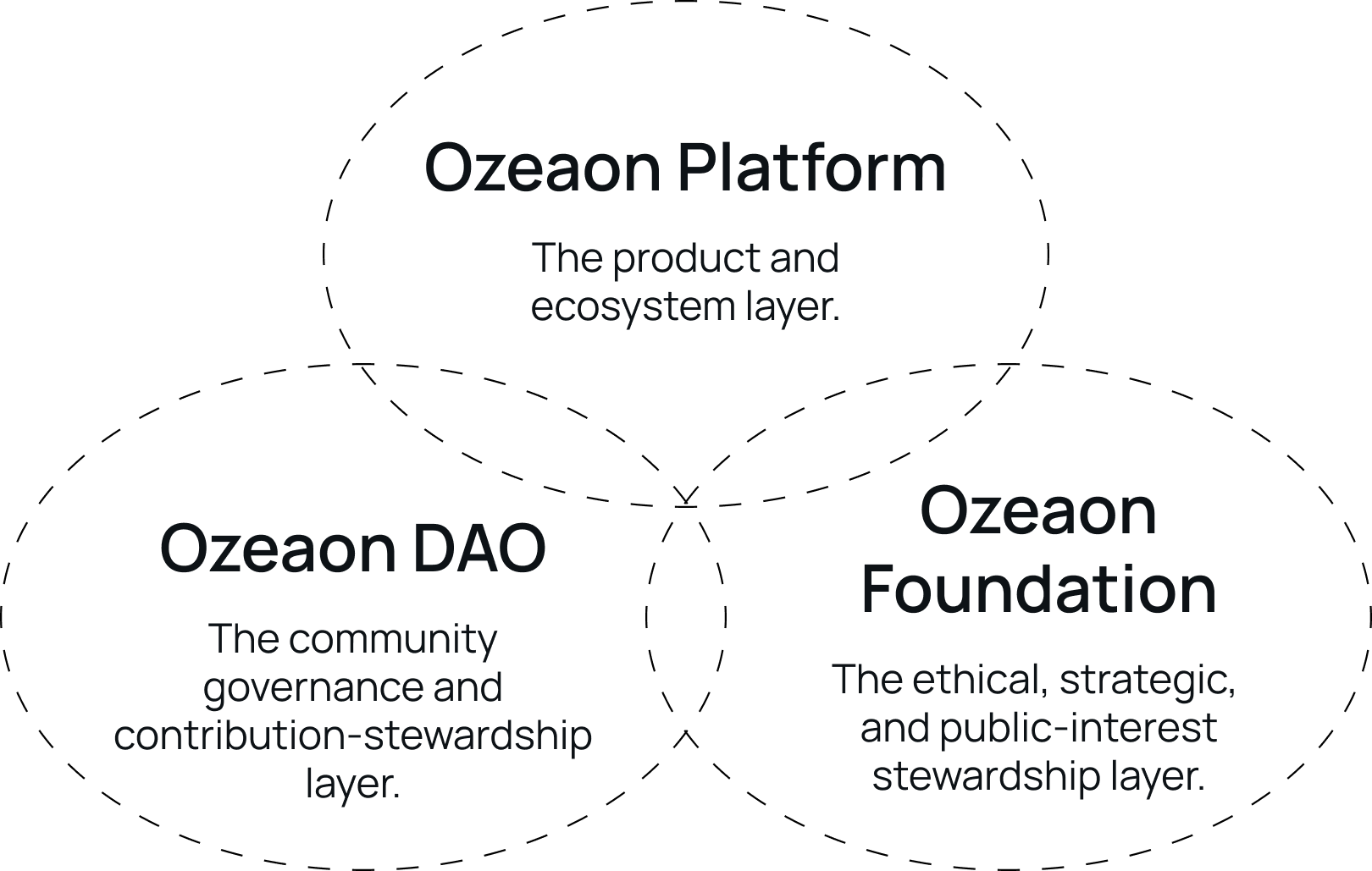
Ozeaon's governance model is designed as a hybrid ecosystem.
The Foundation is not designed to replace community governance. The DAO is not designed to operate without safeguards. Together, they create a balance between participation and responsible oversight.
A group of educators proposes that Ozeaon create a new learning pathway on regenerative aquaculture. Contributors discuss the proposal, vote through Progress-linked eligibility, and the approved topic is prioritised for curation.
A research-informed article on blue carbon receives strong community feedback. Users propose it for elevated visibility and adaptation into an Educational Resource.
A coastal restoration project publishes updates, evidence, and community engagement. Contributors propose it for featured visibility or connection to relevant open calls.
Users request improved filtering for open calls by location, funding amount, eligibility, and deadline. A proposal is submitted, discussed, prioritised, and added to the product roadmap if approved.
A user supports a regenerative project with a small donation or tip. Celo's low-cost transaction environment helps make small-value support more practical than it would be on high-fee infrastructure.
In a later phase, the DAO considers whether to acquire rights to a useful educational or regenerative IP-NFT that could support the platform's knowledge ecosystem.
The Ozeaon DAO is a developing governance layer. It will not be fully active as a decision-making system at the early access stage before platform launch.
DAO-related areas should appear as Coming Soon, helping users understand the long-term direction without implying active governance before the required safeguards, token infrastructure, legal review, and community processes are ready.
Ozeaon is taking a phased approach so governance can develop with trust, clarity, accessibility, and accountability.
DAO development, Progress model, ethical tokenomics, Celo alignment, Foundation relationship, and interface build-out.
DAO Activity appears as Coming Soon while the core platform focuses on resources, articles, projects, open calls, organisations, profiles, and participation.
Celo-based blockchain infrastructure introduces Progress tokens, $Ozeaon utility, participation rewards, tipping, funding flows, voting, review and DAO foundations.
Progress-linked quizzes, IP-NFTs, Bounties, delegation, review, curation, and stewardship workflows.
You might also be interested in
Ozeaon is being developed with researchers, educators, innovators, organisations, communities, funders, and partners who believe knowledge should lead to action.
Join early access, explore partnership opportunities, or preview how the platform is being built.