Ocean as Muse: Art Meets Ecology at the Venice Biennale 2026
Art can make environmental change felt in ways that data alone often cannot. At Ozeaon, this connection between knowledge, culture, science, and action sits at the heart of our work.
By Agnese Rossi
“The minor keys are the small islands, worlds amid oceans with distinct and endlessly rich ecosystems, social lives that are articulated, for better and worse, within much larger political forms and ecological stakes. Here, the evocation of the key and the island extends to an archipelago of oases [...] – the other worlds that artists make, the intimate and convivial universes that refresh and sustain even in terrible times; indeed, especially in terrible times.
These are the cues for an exhibition.” (Koyo Kouoh, In Minor Keys)
In Minor Keys is the theme chosen by Koyo Kouoh for the 61st International Art Exhibition at the Biennale in Venice. At the heart of it lies the concept of beginning the process of creation from one’s own backyard, finding the beauty in little things, intimate worlds and overlooked realities. And it’s interesting to see how many artists, in their interpretation of this, chose the ocean as their muse.
Many of the exhibitions at this year’s Biennale are in fact centered on the sea and the ocean as the basis of life. “Regulator of climate, keeper of memory, site of relation between human and more-than-human worlds: the ocean is at once the medium through which these questions travel and the body in which they are held”, states the publication accompanying AS ABOVE, SO BELOW, a collateral event of La Biennale. Developed thanks to the collaboration between One Ocean Foundation and ZEITGEIST19, it presents a logic of interdependence between surface and depth: “what moves in one register reverberates in another”.
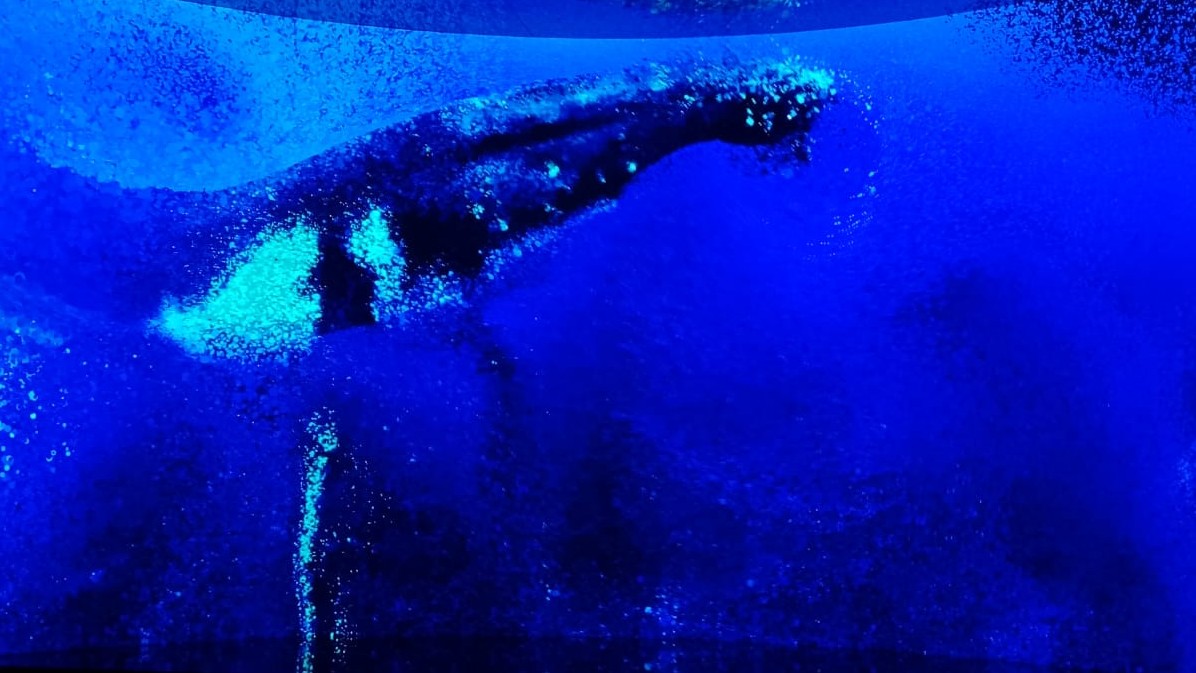
That’s exactly what we find right in front of us as soon as we enter the exhibition, with Seeing Echoes in the Mind of the Whale, by Marshmallow Laser Feast, a video installation exploring the sensory world of cetaceans. “The work draws on whale vocalisations and bioacoustic research to bridge the distance between human perception and the complex acoustic intelligence of marine life”, deepening our connection to these creatures. Through this installation, viewers are invited to immerse themselves in this mysterious underwater world, guided by three species - a bottlenose dolphin, a humpback whale, and a sperm whale - following them as they surface for breath before diving once more into the depths.
But art is not only a means through which we can experience the many beauties of the sea. In Requiem for the Caspian, it also becomes a way to draw attention to ecological crises that increasingly shape everyday life for some communities while continuing to be ignored by most of the world.
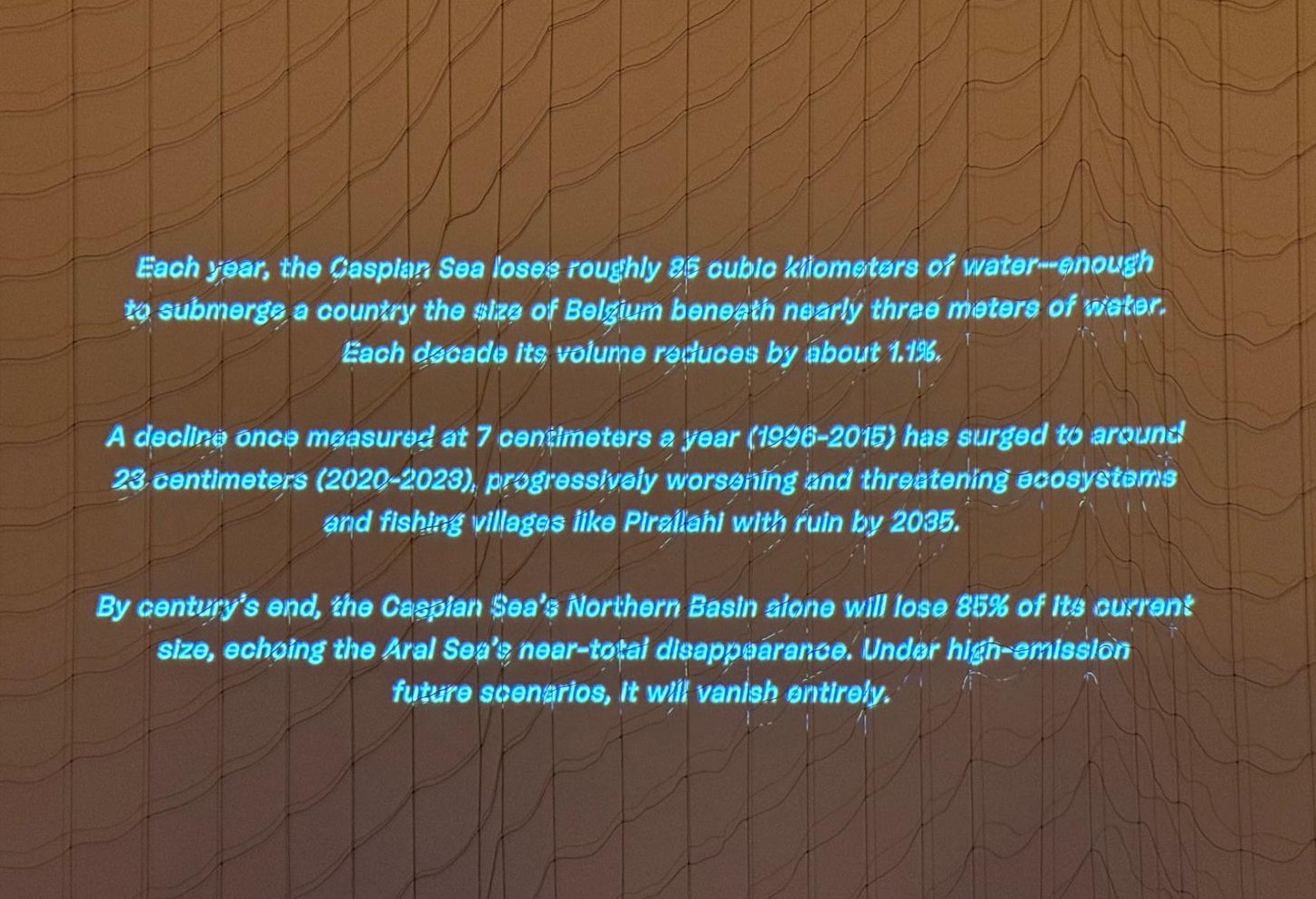
On the island of Pirallahi, off the coast of Baku, residents of an old village are witnessing the disappearance of a sea that has defined their memories and their identities since childhood. “The film frames this disappearance not only as environmental collapse but as a form of cultural and physical colonisation, a territory remade by extractive economies, where landscape, narrative, and memory are occupied, renamed and repurposed.”
The same theme emerges from a different perspective in the Romanian pavilion, where the video installation Blue Ground gives voice to the environment through the narration of its own exploitation. Here, the sea is no passive element, but a resonant system that reflects back humanity’s actions toward it.
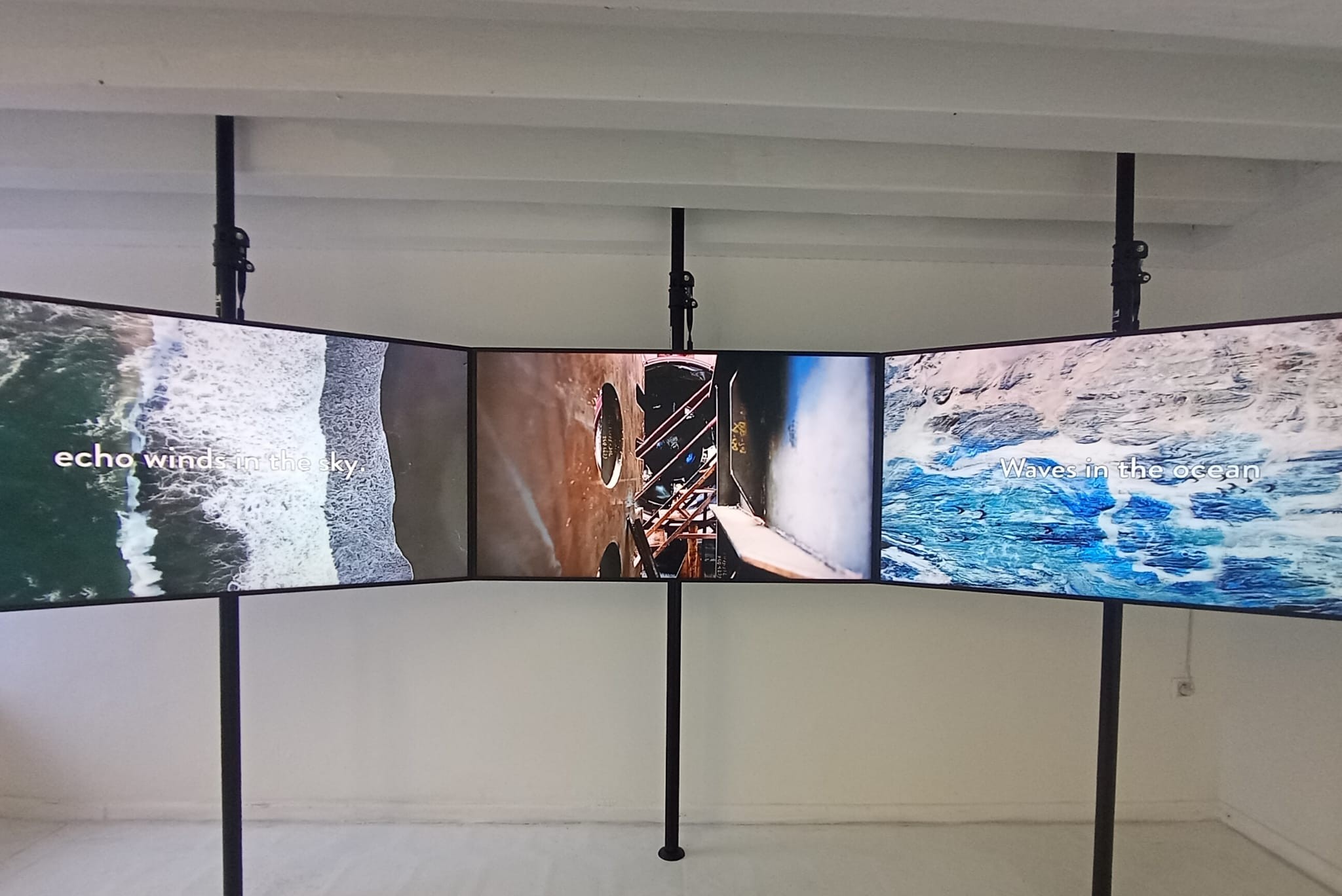
“The project unfolds as a multi-layered installation in which sound, moving image, sculpture and scientific material form a shared field of inquiry”, explain Corina Oprea and Diana Marincu in their curatorial introduction, referring to the exhibition Black Seas - Scores for the Sonic Eye by Anca Benera and Arnold Estefán. “The artists offer a reading of the Black Sea that is mediated by the oceanographic processes, infrastructures of extraction, and overlapping histories of empires and trade routes connecting it with the Mediterranean and the Atlantic”, delivering this fascinating portrayal of the sea as an archive.
Before concluding, special mention should be made of the debut of the world’s smallest island country, Nauru, at this year’s Biennale, with the exhibition AIM Inundated, Imagining Life After Land. Developed through collaborations between international artists, the project addresses environmental decline, reflecting on how histories of extractive activity and post-colonial impact have made Nauru a place where the consequences of global decision-making reverberate and shape the life of its community.
As the Biennale unfolds, the exhibitions represent the environment not as something separate from humanity, but as something deeply entangled with it. The artists give form to this connection, inviting viewers to feel it for themselves. So, if you happen to stroll through Venice’s alleys, allow yourself to take a plunge in these extraordinary exhibitions.
Agnese Rossi
Journalistic Content Intern
Agnese Rossi supports public engagement at Ozeaon, helping strengthen the company's audience-facing communication, community outreach, and public visibility.
Her role contributes to how Ozeaon engages external audiences through accessible storytelling and mission-aligned content.
- Journalism
- Communications
- Public Engagement